DSTG researchers recognised for advancing sovereign uncrewed aerial capability
Six Defence Science and Technology Group (DSTG) researchers have been recognised as part of a high-performing national team supporting sovereign uncrewed aerial system (UAS) capability for the Australian Defence Force (ADF).
The Advanced Strategic Capabilities Accelerator (ASCA) Sovereign UAS Challenge Team received a Vice Chief of the Defence Force (VCDF) Capability Commendation (Group Award) at the 2026 VCDF Capability Awards, presented by Air Marshal Robert Chipman AO CSC. The award acknowledges the contributions of the team members behind this ambitious, fast-paced initiative designed to accelerate innovation and strengthen Australia’s defence industrial base.
DSTG’s autonomous systems researchers Dr Kent Rosser, Dr John McGuire, Dr Artur Medon, Jonathan Dansie, Andrew Ellis and Siddhant Tandon were members of the award-winning team.
Running from December 2023 to July 2025, the Sovereign UAS Challenge was ASCA’s first major program. It set a clear and demanding brief to Australian industry: develop a UAS weighing under 2kg, with a stable camera, a minimum range of 5 kilometres and costing less than $5,000.
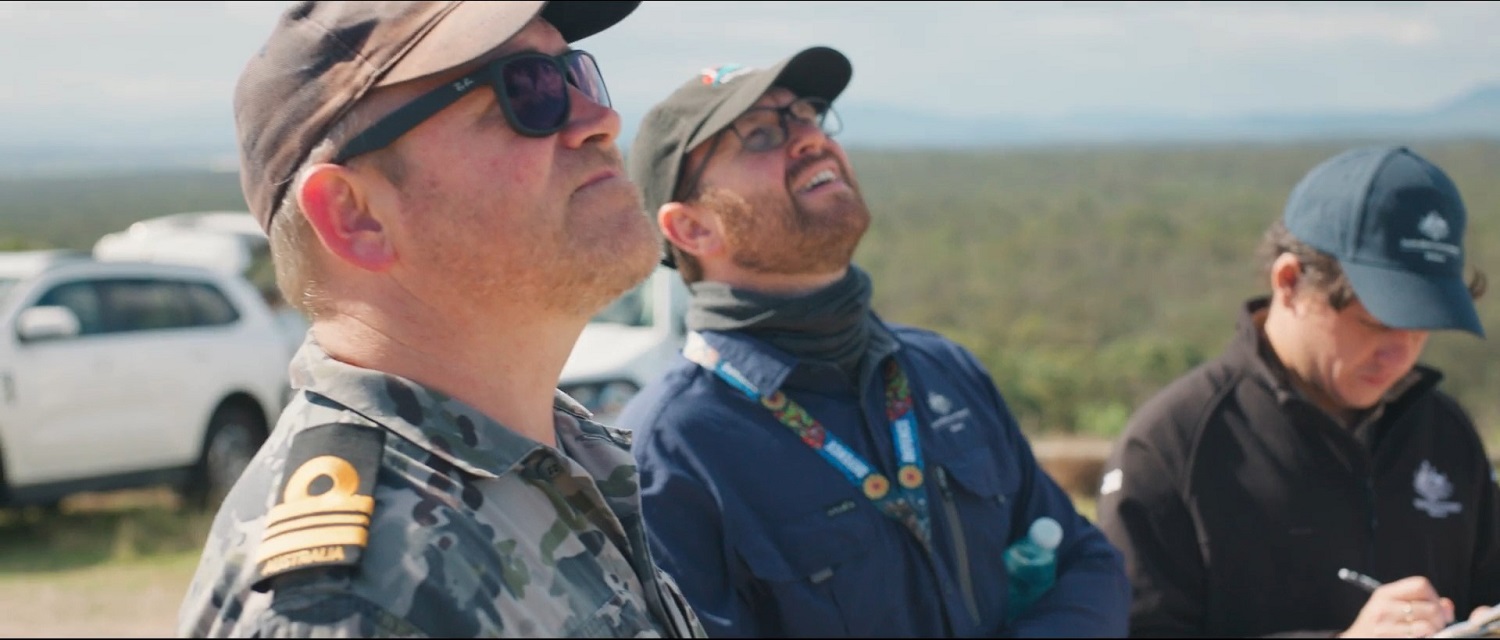
DSTG’s autonomous systems researchers played a central role in the technical evaluation of competing systems. Working alongside Defence and industry partners, they reviewed documentation and conducted rigorous testing of prototype platforms, assessing flight performance, control systems and sensor integration against a comprehensive set of operational requirements.
Drone fly-off, and then there were three
In April 2024 ten shortlisted Australian companies participated in a competitive “fly-off” demonstration. Each received funding to refine their concepts and demonstrate capability under realistic conditions.
Dr Rosser’s team has accrued drone flight trial experience over many years and provided that subject matter expertise to ASCA for the challenge. Work included the review of technical documentation and participation in the drone flight trials. The Defence scientists were instrumental in designing and executing the evaluation framework, ensuring a consistent and technically robust assessment process.
‘Following the initial fly off demonstration, our team supported the further down select of three systems (from AMSL Aero, Boresight and Grabba Technologies) for initial production of 100 units each,’ says Dr Rosser. ‘We then supported the further assessment of their production standard systems during flight testing. The activity contributed to Defence outcomes by adding the selected sovereign UAS types onto a standing offer panel to enable streamlined acquisition across government; increasing Defence familiarity and proficiency with low cost UAS; and strengthening Australian industry design and manufacturing capability in this domain.’
‘It was an interesting, informative exercise, and really good to see that each company had their own unique take on the challenge and each solution had its own unique advantages,’ adds Dr Medon. ‘For me, this VCDF Award is great acknowledgement of DSTG’s involvement in this wider program supporting Defence capability. Everyone in our team is happy to get out there and take on additional responsibilities beyond our own project work to support the ecosystem. Having the opportunity to work on initiatives like the Sovereign UAV Challenge with ASCA and ADF peers, and contributing to Defence outcomes is fantastic.’
Technical assurance and sovereign industry support
The program was delivered within a compressed timeframe and required close coordination across Defence, industry and research stakeholders. DSTG’s contribution included not only technical assurance, but also deep collaboration with industry to support rapid iteration and problem-solving throughout the development cycle.
Beyond the immediate capability outcome, the Sovereign UAS Challenge has helped establish an enduring pathway for Defence to access Australian-developed uncrewed systems. This challenge has directly supported Sovereign Defence Industrial Priority 5—Development and Integration of Autonomous Systems—and delivered a tangible uplift to the operational effectiveness of the ADF.
By combining technical excellence with an agile, collaborative approach, the Sovereign UAS Challenge team has demonstrated how Defence can rapidly translate innovation into capability—placing cutting-edge systems into the hands of Australia’s sailors, soldiers and aviators.
The achievement reflects the strength of Australia’s growing sovereign defence innovation ecosystem, and DSTG’s ongoing role at its forefront.
- Read Defence’s Sovereign UAS media release here: Growing sovereign industrial base with 300 drones delivered to Defence | Defence
- Watch a video about the Sovereign UAS Challenge here: Blue-sky thinking for ASCA’s UAS Challenge | Advanced Strategic Capabilities Accelerator