
Printing micro-livers to save lives
Nerve agents are a big threat to our Defence force. If personnel are exposed (or potentially exposed) they're treated with countermeasures known as oximes. Because the level of exposure is most often unknown, the maximum oxime dose is normally given, and that can cause liver damage.
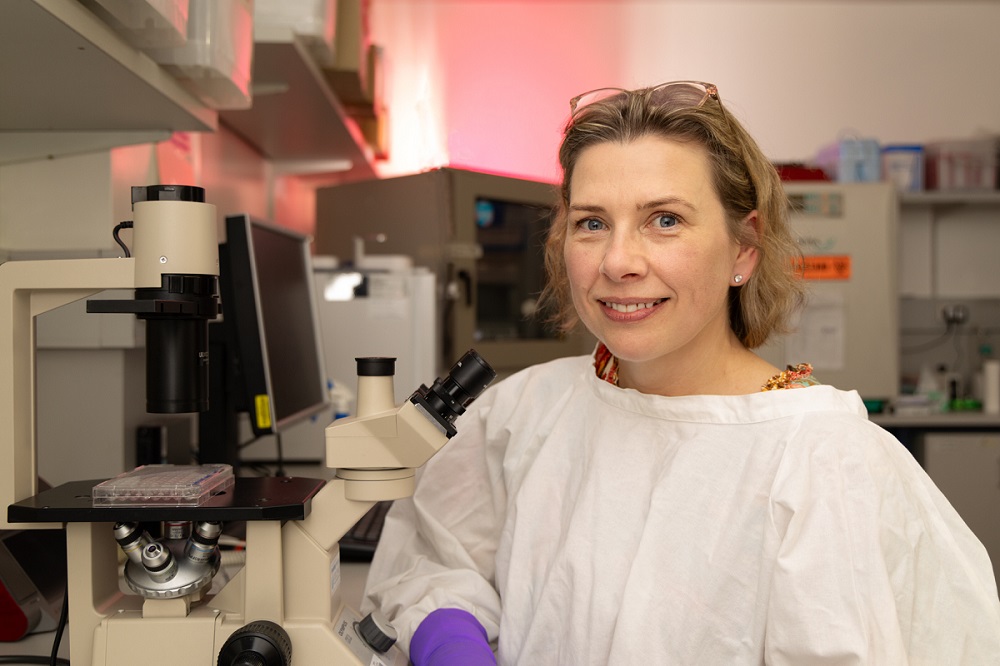
Natalie Withington, a molecular biologist at DSTG, is contributing to a research program that is investigating whether alternative drugs can be used as nerve agent countermeasures. This research, including the acquisition of new bio-printing equipment, is supported by Joint Health Command.
‘The big drug manufacturers are also looking a lot more at repurposing these days, because new drug development is a long and very expensive journey,’ explains Natalie. ‘The idea is to see whether drugs that have already been manufactured and approved can treat other conditions.’
‘For our research we want to assess a drug’s interaction with livers, and for that we need access to liver cells. Through a materials transfer agreement with Swinburne University we have been given some human embryonic stem cells originally taken from an embryo back in the '80s.’
To accelerate this important research, Defence recently acquired a highly-precise RASTRUM Allegro 3D cell bio-printer. Bio-printing is like 3D printing, but instead of depositing layers of polymer, bio-printing uses a dispenser to deposit layers of cells to form a 3D miniature organ surrogate known as an organoid.
Natalie is stepping through cell culture protocols to differentiate the stem cells into individual liver cells, and will then use the bio-printer with the liver cells to attempt to create miniature livers in the lab.
‘The plan is then to expose our mini-livers to nerve agents and then see if there are any drugs that we can repurpose to act as countermeasures,’ she reports. ‘We’ll also measure the point at which countermeasures become toxic to the liver. The payoff for Defence is that if we succeed our warfighters will have access to better treatments.’
Long route to a career in Defence science
Natalie took a long route to a Defence science career; one that required patience and persistence.
‘I really enjoyed science in high school, but someone said to me “There's no money in science”. I had it in my head as a very naive girl that I needed to buy my mum a house because we were renting. So I set my sights on international trade and did an arts/commerce degree.
‘As soon as I had my first child I went back to university to study science, and just studied part-time for a couple of years, had a break while I had another child, did a couple of years, had a break while those kids were in kinder, and then had another child. And then, I just went back very slowly, one subject at a time. Once my youngest was at school I was ready to get into it. But then COVID hit and I was home-schooling three children. So then back to one subject a semester again!’
Natalie’s perseverance paid off, she graduated from Swinburne University in 2023 with a major in biotechnology.
‘I then applied for a Defence STEM cadetship, got that and was supported to do my Honours year in 2024. That was the first time studying full-time with all my kids, and it was very hectic because I was still working two days a week at Melbourne Pathology. I love cell culture, but it wasn’t great for an Honours project because I had to go in to tend to the cells seven days a week!’
A great workplace
It seems that at DSTG, Natalie has found the perfect workplace for a freshly-graduated molecular biologist.
‘I actually love the whole place,’ she says. ‘When I came and did my undergraduate placement here, I thought it was fantastic because you get paid to investigate things in the lab. What's not to love? The people here are wonderful and I enjoy the variety in the work. The projects are generally three to five years in length and then you get to try something else. I just really enjoy everything about working here at DSTG.’