
Listening out for composite material defects
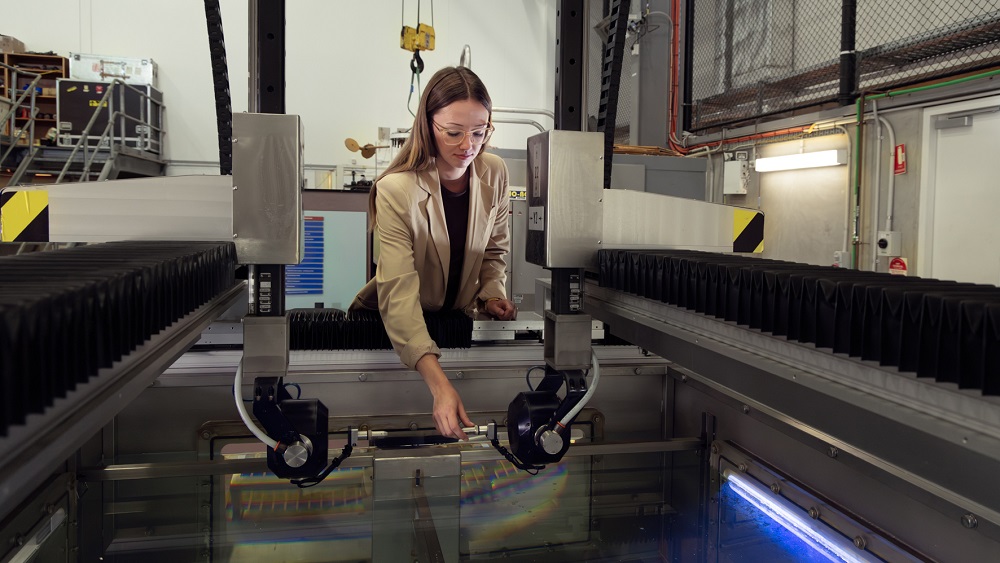
How do you examine the inside of a material to check for defects without damaging it? One way is by listening to its response to sound waves, and that’s what mechanical engineer Hannah Spratling does in a lab at DSTG Fishermans Bend.
Doctors use percussion (tapping on a hand laid on a patient’s chest) to determine the density of the chest tissue; abnormal areas (for example, where fluid is collecting) sound different. And sonographers use ultrasound to look at material changes in the human body. In much the same way, Hannah’s team uses ultrasonic non-destructive testing (NDT) to measures changes in acoustic impedance to pinpoint defects in manufactured materials. The technique, which uses sensitive transducers to digitise the sound waves, is very effective for detecting internal air-based defects in composite materials. The size and depth of defects can be measured, and even the different types of defects, namely delamination (separation of layers), micro-cracking, voids, inclusions, and porosity.
When the test item and ultrasonic signals are submerged in a bath of water, it’s easier to hear the results, which is why DSTG’s highly-accurate, 11-axis, automated TecScan Systems ultrasonic scanner operates in a water tank.
‘Sound travels very poorly through air but quite well through water and other liquids or gels,’ says Hannah. ‘Our immersion scanner allows for much better coupling between sensor and test material. In a similar way, sonographers use a gel for coupling when generating medical ultrasounds. We place material samples between two probes in the water bath. One probe fires the ultrasonic signal and receives the reflected echo, known as pulse-echo. The second probe on the other side measures the signal that transmits straight through the material, known as through transmission. We program points across a test material, after which the robotic system automatically does a series of line scans. By measuring the amplitude of the signals received from the back wall, any internal reflections, and the sound received through the material, the TecScan software creates three-dimensional “c-scans” visually showing any changes in impedance inside the sample.’
The materials that Hannah analyses are often flat test coupons of carbon fibre composites fabricated by her Defence science colleagues.
Plenty of interesting work for a young graduate
Hannah’s mechanical engineering studies at RMIT were bolstered by a DSTG STEM cadetship.
‘I grew up with family in the ADF and I'd always been interested in a job with Defence, so DSTG was on my radar,’ she says. ‘The cadetship was a great opportunity to be paid while I studied, and then have a guaranteed job at the end.’
During breaks in her fourth year studies, she could be found in the Fishermans Bend laboratory characterising novel materials. She was able to carry out her Honours project on the same work, measuring the acoustic attenuation of materials. Now a permanent member of the team, Hannah is adding expertise in ultrasonic NDT to her skillset. Her team is gearing up to support RAAF engineers and technicians with the NDT analysis of the newly-acquired MQ-4C Triton uncrewed aerial platform, particularly fracture-critical bond lines. She is learning from seasoned DSTG colleagues ready to share a wealth of experience gained analysing the RAAF F-111 and Classic Hornet platforms.
The laboratory research builds up knowledge and awareness of the type of internal damage to platform surfaces and structures that can be created from different impacts and fatigue. The benefit for Defence is that fleet managers get to understand the behaviour of the different materials used in the different platforms. In addition, scans can be done after repairs, to check repair quality.
Choosing the most appropriate ear
According to Hannah, when planning ultrasonic inspections on a new material or system the selection of the probe is critical for ensuring that internal defects are identified. There are probe trade-offs to be considered such as frequency, beam size and focus length. Some “ears” are better for listening out for certain types of defects, or work best with certain materials. For example, choosing a probe with a higher ultrasonic frequency will increase the resolution of the output scan, but the acoustic attenuation of materials also increases with frequency, potentially reducing signal clarity.
Hannah and colleagues Joseph Dominguez and Dr Matthew Ibrahim are currently investigating the effects of ultrasonic system selection on the characterisation of defects. For the study, they are deploying the immersion scanner to investigate a set of both epoxy repairs and barely visible impact damage (BVID) in carbon fibre-reinforced polymers. A secondary study using phased array inspection methods (a more sensitive “multi-ear” method) will also be completed. The result will be a comparison of the effects of a range of system characteristics including frequency, element size, focus length, number of phased array elements and aperture.
The trio are looking forward to exploring the use of acoustic attenuation as a means to characterise the quality of an epoxy repair (how much air is in there), and the severity of BVID (changes to stiffness). They plan to share their results in a paper at the International Council of Aeronautical Sciences (ICAS) 2026 conference in Sydney in September.