“Waste not, want not” – researchers to create a new energy source for Defence
A new multi-state research collaboration will advance innovative waste-to-energy solutions to support Defence operations across northern Australia, and Defence scientists are playing a key role in ensuring the results are well-aligned with Defence needs.
The collaboration, the Northern Australia Defence Project, is the first national initiative delivered through the Australian Defence Science and University Network (ADSUN).
Solutions will be developed for critical Defence waste management priorities through research led by six Australian universities — James Cook University, Griffith University, Charles Darwin University, Curtin University, Murdoch University and Edith Cowan University.
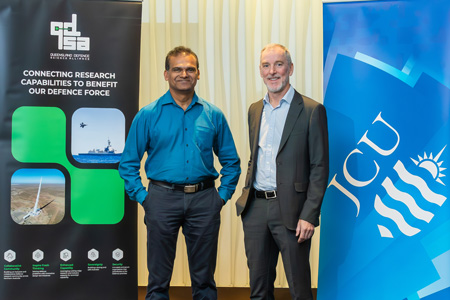
Professor Mohan Jacob, a pioneer of innovative waste-to-energy systems at James Cook University over many years, will lead the project. Research efforts will focus on deployable microgrid and waste management systems capable of converting operational waste into usable energy.
Solar photovoltaic generation will be integrated with battery storage and waste-to-energy technologies to deliver resilient, scalable energy solutions suitable for remote environments.
The outcomes will support Defence by improving access to reliable power, reducing logistical demands, strengthening energy independence and enabling more sustainable operations with reduced reliance on vulnerable supply chains.
This work also advances Defence’s clean energy and Net Zero priorities under the National Defence Strategy.
Defence scientists focus ADSUN efforts
The milestone project has contributions from two ADSUN nodes: the Queensland Defence Science Alliance (QDSA, representing universities in Queensland and the Northern Territory) and Western Australia’s Defence Science Centre (DSC). Defence scientist Dr Roger Stuckey, currently Associate Director at the QDSA, acknowledges that waste-to-energy technology is an area not typically associated with Defence IS&T, but says it is one of high importance to the ADF and very topical at the moment!
Dr Stuckey played a key role in standing up the Northern Australia Defence Project, from project scoping through to the co-design and assessment of proposals. ‘We developed the project in consultation with representatives from the QDSA and DSC ADSUN nodes, DSTG, Defence Security and Estate Group, the Defence Energy Transition Office and Army Headquarters 1 Division,’ he says. ‘This level of engagement required a significant amount of effort and coordination, but we wanted to ensure that the project was well-aligned with the needs of Defence.’
Roger says he is proud to be a part of this national ADSUN project that will provide logistical solutions by reducing waste generated at Defence bases and converting it into energy, thereby significantly boosting the autonomy and sustainability of operations.
‘The project also promises operational gains such as increased supply chain resilience and superior environmental performance by integrating the waste-to-energy system, along with other alternative energy harvesting and storage solutions, into scalable microgrids for use in deployed and fixed-base contexts.’
DSTG’s ADSUN Program Leader Dr Craig Rogers says that the cross-state, cross-university collaboration seen in this project is a sign of a bright future, evidence of an evolving, collegiate approach as the ADSUN makes progress in providing a more focused, asymmetric academic and industry-enabled advantage to Defence.
‘Dr Stuckey’s lead role in standing up this project, especially the close engagement with ADF stakeholders, highlights the valuable role DSTG’s Associate Directors are playing in the ADSUN nodes,’ says Dr Rogers.
Read more about ADSUN here: https://www.dst.defence.gov.au/partner-with-us/university/adsun.
Read the Defence media release about this Waste-to-Energy Project here: https://www.defence.gov.au/news-events/news/2026-03-27/defence-project-powers-waste-energy-innovation.